

There Will Always be Power Centers
And Rulings become Rules

I saw the below posted by someone the other day.
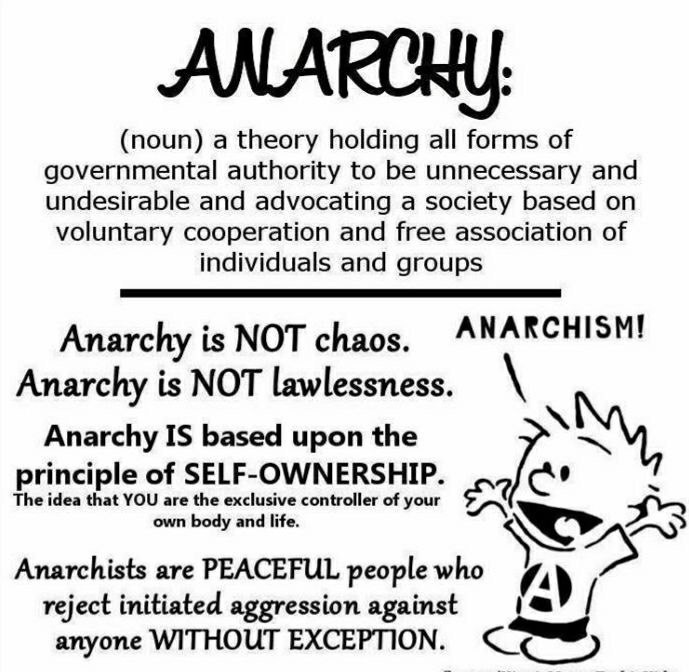
Let’s set aside the “no true scotsman” aspect of the violent anarchists and fellow traveller communists of the early 20th century, and simply look at the top, and then the bottom. Free associations of groups, without an overarching government, by definition means there are no laws - or, by definition, it is lawless. Because unless enforced, you can write all the laws you want, they are worthless.
It’s something that always bugged me despite my libertarian-ish leanings. I have nine neighbors. we each have a plot along a street. Nine of us have agreed that we’re not going to have loud parties outside at three in the morning. The other simply owns his land with his house and never agreed.
He throws parties.

Loud ones, that can be heard half a mile away.
24 hours a day.
By some miracle he’s got enough parking on his property, and picks up the trash left around his place, but the constant noise, the traffic, the inability to walk alongside the road for fear of getting run over by the uptick in drivers, the smoke, what have you makes everything a mess for the other nine.
“But the guy owning the road can bar access to it”
What if they’re in cahoots because that guy likes the parties, or the money he’s making from tolls. He’s not one of the neighbors, so he isn’t impacted by the rest. or any of a dozen other reasons that he won’t block access. And if it’s the only road in or out, it’s not like you can practically cut off your tolls in protest.
But why would the owner by different? Why not have it be owned by the community that it provides monopoly access to? and they have to sign into the covenants?
Sure, Okay. Maybe the smart thing to do would have been to do that. But they didn’t. And either way, however far you push back the “ownership” and “agreed community standards”, you eventually run into a point where someone else is at the boundary of what “you” and your buddies control, who also may not agree with you, but instead with your problem neighbor. Or just not care.
You cannot call the cops over it. There is no government per se. Who is going to enforce the agreed upon rules, especially on someone who did not agree on them?
A short break
Let’s get several things established. As Alex Macris has made clear in discussions of game rules, in games, and especially role playing games because they are more “sandbox” in nature, you have rules-light games, and rulings-light games. Granted, a good cohesive ruleset can both minimize the amount of written rules that need to be memorized for any level of abstraction in the game, as well as minimize rulings, or provide a framework to make them consistently easy without having to significantly alter anything or add to the rules. But every time you run into something not covered by the rules, you have to make a ruling. Which unless completely arbitrary, forms the foundation, a precedent, for how that question is resolved later, and it becomes, for you and your friends playing that game, a rule in effect.
This is incidentally - in simplified manner - how British Common Law works. Accumulated precedent and compromises that may or may not have been codified into “laws”.
But they are de facto laws, nonetheless.
And they grow out of the very premise that “anarchists” - at least the kind in the meme - embrace. People get together and decide what standards they’ll have between each other. This may be overt agreement, or simply through mutually developed empirical understanding due to months, years, or even generations of accepted behavior, and what is not accepted. Put a pin in that last. This is also the source of the term “unwritten rules” - cultural norms that are not written down but have to be relayed, or observed and noted.
But people being people, whether for greed, the raw desire to enjoy other’s suffering, cluelessness, selfishness, or other reasons, sometimes refuse to follow those norms, written or otherwise. And won’t respond to kind words.
The issue here is that the tragedy of the commons doesn’t just apply to property, but to ephermal and immaterial things like norms and standards. If they’re not enforced, there are no standards.
And force implies someone with the moral authority to escalate physical force, up through violence, and, if resisted strongly enough, to deadly force. Because if the guy fucking with you knows you won’t hurt him, just push him around a bit, that he won’t suffer any consequences, why would he stop? He’s not going to jail if he resists enough, nor is he going to get hurt or die.
But we can exile him…
You and what army? Someone has to escort said asshole to the border or perimeter, and someone has to make it stick. That means hiring someone to guard the border, or agreeing to turns, and in either case, if he comes back, catching him and taking him back. Again. One again, force is initiated for the “common good” by someone delegated, whether by the “people” (let’s set aside the issue of diluted responsibility, so nobody is) or by a ruler.
There’s also the issue that men form hierarchies, it’s practically instinctive. A group of guys hanging out, one guy will make the suggestions the rest follow, and people drop into various roles. Sometimes the bully is in charge, sometimes not. In either case, you end up with gangs of people who feel some degree of loyalty to each other, which immediately blows any sense of “anarchy” out of the water. Sure, you can say it’s “voluntary” to toss a fig leaf on it, but in the end, if you want to be part of that community, unless you happen to be the guy everyone follows, someone else sets the rules, and you’re expected to follow them.
Meet Our Friends
The Last Redoubt is a reader-supported publication. To receive new posts and support my work, consider becoming a free or paid subscriber.
Please also join the Pilum Press Discord and/or the Autarch Discord. Pilum is the publisher of several books and short story collections including Shagduk and Thune’s Vision. Autarch is the home of the Adventurer Conquerer King RPG.